
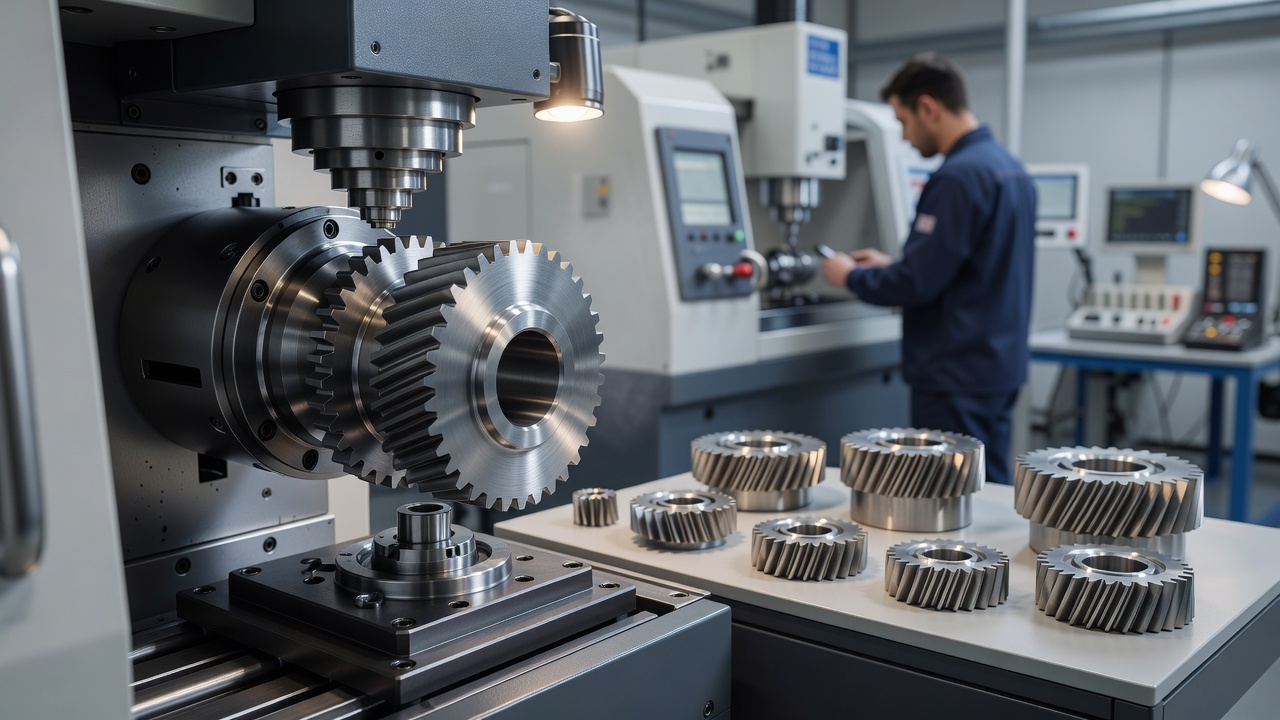
Developing a new mechanical system often requires more than validating a design on a computer screen. Gears operate under real loads, speeds, lubrication conditions, temperatures, and alignment constraints that simulations cannot always represent perfectly. Prototype gear manufacturing bridges the gap between digital engineering and full-scale production by creating functional gears that engineers can inspect, assemble, test, and refine before committing to expensive tooling or high-volume manufacturing.
Prototype gears are used across industries including automotive engineering, robotics, aerospace, industrial automation, medical equipment, defense, energy, agriculture, and product development. A prototype may be required to evaluate tooth geometry, backlash, noise, durability, shaft alignment, material performance, or the way an entire gearbox behaves under operating conditions. In some projects, only one gear is needed. Others require dozens or hundreds of parts for engineering validation and pre-production testing.
The most appropriate manufacturing process depends on far more than speed. Gear type, module or diametral pitch, pressure angle, tooth quality, material, heat treatment, surface finish, production quantity, and inspection requirements all influence how a prototype should be made. This guide explains the complete process and the practical decisions that can help engineers move from concept to a reliable physical gear.
What Is Prototype Gear Manufacturing?
Prototype gear manufacturing is the production of small quantities of gears for engineering evaluation, design validation, testing, demonstrations, or early-stage product development.
Unlike mass production, where tooling and processes are optimized for thousands or millions of identical components, prototype production prioritizes flexibility.
Typical quantities may range from:
- A single engineering sample.
- Several design variants.
- Small validation batches.
- Low-volume pre-production runs.
The objective is to produce a part representative enough of the intended design to answer meaningful engineering questions.
Why Prototype Gear Manufacturing Matters
A gear can appear correct in CAD software but behave differently after assembly.
Physical testing can reveal problems involving:
- Backlash.
- Tooth contact.
- Noise.
- Vibration.
- Alignment.
- Wear.
- Lubrication.
- Assembly clearances.
Discovering these issues during prototyping can be considerably less disruptive than identifying them after production tooling and supplier commitments have already been finalized.
1. Validate Gear Geometry Before Production
One of the main advantages of prototype gear manufacturing is the ability to confirm whether the designed geometry functions as intended.
Important parameters may include:
Number of Teeth
Tooth count affects gear ratio and physical dimensions.
Module or Diametral Pitch
These systems describe tooth size and must be compatible between mating gears.
Pressure Angle
Pressure angle influences tooth interaction and load transmission.
Helix Angle
Helical gears require precise control of helix geometry.
Backlash
Appropriate clearance between mating teeth supports operation while accounting for manufacturing tolerances, lubrication, temperature, and system requirements.
A physical prototype allows engineers to test these interacting variables within the actual assembly.
2. Test Multiple Gear Materials
Material choice significantly affects performance.
Common gear materials include:
Carbon and Alloy Steels
Steels are widely used for gears requiring strength, durability, and heat-treatment capability.
Stainless Steel
Certain stainless alloys may be selected where corrosion resistance or specialized operating conditions matter.
Aluminum
Aluminum can be useful for lightweight mechanisms and certain prototype applications.
Engineering Plastics
Materials such as acetal, nylon, PEEK, and other engineering polymers are used in applications requiring low weight, low noise, corrosion resistance, or other specialized properties.
Prototype gear manufacturing allows design teams to compare candidate materials before selecting the final production specification.
3. Reduce Development Risk
Engineering changes become more expensive as a project moves toward production.
A tooth-profile adjustment made before tooling is usually easier to accommodate than one discovered after a large production batch has been completed.
Prototyping can help identify:
- Design errors.
- Assembly interference.
- Unexpected noise.
- Bearing-load issues.
- Material problems.
- Lubrication concerns.
That knowledge helps teams refine designs before higher-cost commitments are made.
4. Support Functional Testing
Not every prototype needs to be fully production representative.
A visual model might be sufficient for a design presentation, while transmission testing requires much closer replication of final geometry and material properties.
Before manufacturing, define exactly what the prototype needs to prove.
Testing goals may include:
- Basic fit.
- Motion.
- Torque transmission.
- Efficiency.
- Noise.
- Temperature.
- Wear.
- Fatigue.
The test objective should drive the manufacturing specification.
5. Compare Design Variations Quickly
Prototype production allows engineering teams to evaluate competing designs physically.
For example, a project may compare:
- Different tooth counts.
- Alternative materials.
- Different face widths.
- Modified backlash.
- Multiple heat treatments.
Producing small batches makes controlled comparison possible without committing to full-scale production.
6. Improve Design for Manufacturability
A technically functional gear may still be unnecessarily difficult or expensive to manufacture.
Prototype gear manufacturing gives suppliers an opportunity to identify production concerns before scale-up.
Design-for-manufacturability feedback might address:
- Tool access.
- Root geometry.
- Bore design.
- Keyways.
- Material availability.
- Inspection difficulty.
- Unnecessarily tight tolerances.
This collaboration can reduce cost while preserving required performance.
7. Create a Smoother Path to Production
The best prototype process does not merely create a working sample; it generates knowledge that can support production.
Document:
- Final dimensions.
- Material.
- Heat treatment.
- Inspection results.
- Process changes.
- Testing outcomes.
This information helps ensure the approved prototype can be reproduced consistently when production volumes increase.
Common Gear Types Produced as Prototypes
Manufacturers may produce many forms of gearing.
Spur Gears
Spur gears use straight teeth parallel to the rotation axis.
They are common in relatively simple mechanical transmissions.
Helical Gears
Helical teeth engage gradually, which can provide smoother operation in suitable applications.
They also introduce axial forces that need to be considered during system design.
Bevel Gears
Bevel gears transmit motion between intersecting shafts in many configurations.
Worm Gears
Worm gearsets can provide substantial reduction ratios in compact arrangements.
Internal Gears
Internal gears have teeth formed on the inside diameter of a ring.
They commonly appear in planetary systems.
Rack and Pinion
A circular pinion engages with a linear rack to convert rotational and linear motion.
Each type presents different manufacturing and inspection challenges.
CNC Machining for Prototype Gears
CNC machining is valuable during prototyping because it provides flexibility and does not necessarily require dedicated high-volume tooling.
Depending on geometry and equipment, CNC processes can create:
- Gear blanks.
- Bores.
- Keyways.
- Hubs.
- Special features.
- Certain tooth geometries.
Multi-axis machining may also make complex prototype forms feasible.
However, the optimal process depends on required gear quality and geometry.
Gear Hobbing
Hobbing is a widely used process for cutting external spur and helical gears.
A rotating cutting tool called a hob generates the teeth as the gear blank and tool move in a synchronized relationship.
Hobbing can be useful for prototype and production quantities when the appropriate tooling is available.
Tool availability can influence lead time, particularly for unusual tooth specifications.
Gear Shaping
Gear shaping uses a reciprocating cutter to generate teeth.
It is particularly useful for certain geometries, including internal gears and designs where hobbing access is restricted.
Manufacturing engineers select between hobbing, shaping, milling, and other methods according to the part requirements.
Gear Grinding
High-precision or hardened gears may require grinding after heat treatment.
Grinding can improve:
- Tooth profile accuracy.
- Lead accuracy.
- Surface finish.
- Dimensional consistency.
It adds time and expense, so engineers should specify grinding only when the functional requirements justify it.
Electrical Discharge Machining
Electrical discharge machining, or EDM, can be valuable for unusual geometries, hardened conductive materials, or features difficult to produce with conventional cutting tools.
Wire EDM may be used for specific gear or spline geometries, particularly during low-volume development.
Production speed and surface characteristics should be considered when selecting the process.
Additive Manufacturing for Gear Prototypes
3D printing can play a useful role in prototype gear manufacturing, but its suitability depends on the test.
Printed gears can be excellent for:
- Form evaluation.
- Assembly checks.
- Low-load motion testing.
- Design demonstrations.
However, a printed polymer gear may not replicate the strength, wear resistance, dimensional stability, or surface finish of a machined and heat-treated steel production gear.
The prototype method must match the engineering question.
Heat Treatment
Many steel gears rely on heat treatment to achieve required mechanical properties.
Processes may include:
- Carburizing.
- Nitriding.
- Induction hardening.
- Through hardening.
Heat treatment can cause dimensional changes, which need to be considered during process planning.
Precision gears may require finishing operations after hardening.
Gear Tolerances
Specifying unnecessarily tight tolerances can significantly increase manufacturing cost.
Critical requirements may involve:
- Tooth profile.
- Lead.
- Pitch variation.
- Runout.
- Bore concentricity.
- Face width.
- Surface finish.
Use recognized gear standards where appropriate and specify accuracy based on functional requirements.
Inspection in Prototype Gear Manufacturing
Inspection converts a prototype from “it looks right” into measurable engineering evidence.
Methods may include:
Coordinate Measuring Machines
CMM inspection can verify many dimensional features.
Dedicated Gear Inspection
Specialized equipment can evaluate tooth profile, lead, pitch, and other gear characteristics.
Composite Inspection
A gear may be rolled against a master gear to assess combined variation.
Surface Measurement
Surface finish can be verified when relevant to performance.
The inspection plan should be agreed upon before manufacturing.
Material Certification and Traceability
Regulated or high-consequence industries may require material documentation and process traceability.
Requirements can include:
- Material certificates.
- Heat-treatment records.
- Inspection reports.
- Lot traceability.
- Special-process documentation.
These requirements should be communicated during quotation because they affect cost and lead time.
How Long Does Prototype Gear Manufacturing Take?
There is no universal lead time.
Schedule depends on:
- Gear complexity.
- Material availability.
- Tooling.
- Quantity.
- Heat treatment.
- Grinding.
- Inspection.
- Supplier capacity.
A simple gear made from available material may move relatively quickly, while a high-precision hardened gear requiring specialized inspection can take substantially longer.
Cost Factors
Prototype gears typically cost more per piece than mass-produced parts because setup and engineering effort are spread across smaller quantities.
Price can be influenced by:
- Material.
- Diameter.
- Tooth geometry.
- Quantity.
- Tolerances.
- Heat treatment.
- Surface finishing.
- Inspection.
- Documentation.
Providing complete engineering information during quotation helps suppliers price the project more accurately.
What to Send a Prototype Gear Manufacturer
A strong request for quotation should include:
- 3D CAD model where appropriate.
- Engineering drawing.
- Gear specifications.
- Material.
- Heat treatment.
- Quantity.
- Tolerances.
- Inspection requirements.
- Required delivery date.
Critical requirements should appear in controlled technical documentation rather than relying solely on informal email descriptions.
Choosing a Prototype Gear Manufacturing Partner
A capable supplier should understand both gear engineering and low-volume manufacturing.
Evaluate:
Equipment
Does the manufacturer have suitable hobbing, shaping, grinding, CNC, and inspection capabilities?
Experience
Have they manufactured similar gear types?
Quality Systems
Does their quality framework align with your industry’s requirements?
Engineering Support
Can they provide manufacturability feedback?
Scalability
If the design succeeds, can the supplier support larger production quantities?
Common Prototype Gear Mistakes
A common mistake is using a low-fidelity prototype to answer a high-load performance question.
Other errors include:
- Incomplete drawings.
- Undefined inspection criteria.
- Excessively tight tolerances.
- Selecting material based only on availability.
- Ignoring heat-treatment distortion.
- Failing to document design revisions.
Clear test objectives reduce these problems.
AI and Gear Engineering
Artificial intelligence is increasingly being integrated into engineering and manufacturing workflows.
Potential applications include:
- Generative design.
- Toolpath optimization.
- Predictive maintenance.
- Inspection analysis.
- Production scheduling.
AI may help engineers evaluate design alternatives, but it does not replace proper mechanical analysis, material expertise, manufacturing validation, or physical testing.
Digital Twins and Gear Development
Digital twins combine physical-system data with computational models.
In gear development, engineers may use digital models to study:
- Loads.
- Temperature.
- Vibration.
- Wear.
- System behavior.
Physical prototype testing can then provide data to refine these models.
This creates a feedback loop between simulation and real-world performance.
Moving From Prototype to Production
Once a prototype passes testing, the design should be formally reviewed before volume manufacturing.
Confirm:
- Final revision.
- Material specification.
- Manufacturing process.
- Heat treatment.
- Inspection plan.
- Packaging.
- Traceability.
- Production quantity.
A successful prototype is not automatically a complete production process. Process capability and repeatability must also be established.
Conclusion
Prototype gear manufacturing gives engineers a practical way to validate tooth geometry, materials, tolerances, fit, noise, durability, and system performance before committing to higher-volume production. Processes such as CNC machining, hobbing, shaping, EDM, heat treatment, and precision grinding can be combined according to the gear type and testing objective, while dimensional inspection provides measurable evidence that the prototype matches engineering requirements. The most successful projects begin with a clearly defined test purpose and complete technical documentation rather than simply requesting a gear that resembles the final part. By working closely with an experienced manufacturing partner and documenting lessons learned during testing, design teams can reduce development risk and create a much smoother transition from prototype to repeatable production.
FAQs
What is prototype gear manufacturing?
Prototype gear manufacturing is the low-volume production of gears for design verification, assembly evaluation, functional testing, engineering development, and pre-production validation.
Which processes are used for prototype gears?
Common processes include CNC machining, hobbing, shaping, gear grinding, EDM, additive manufacturing, heat treatment, and specialized finishing.
Can prototype gears be made from production materials?
Yes. Functional prototypes are often produced from the intended production material when testing needs to represent real mechanical performance.
How many gears can be made in a prototype run?
Quantities can range from a single component to small or medium validation batches. The appropriate quantity depends on testing and development requirements.
How accurate can prototype gear manufacturing be?
Accuracy depends on gear geometry, equipment, process, finishing, and inspection requirements. High-precision prototypes can be manufactured when the application justifies the additional processes and cost.
What information does a gear manufacturer need for a quote?
Provide engineering drawings, CAD data where appropriate, tooth specifications, material, heat treatment, tolerances, quantity, inspection requirements, documentation needs, and target delivery date.