
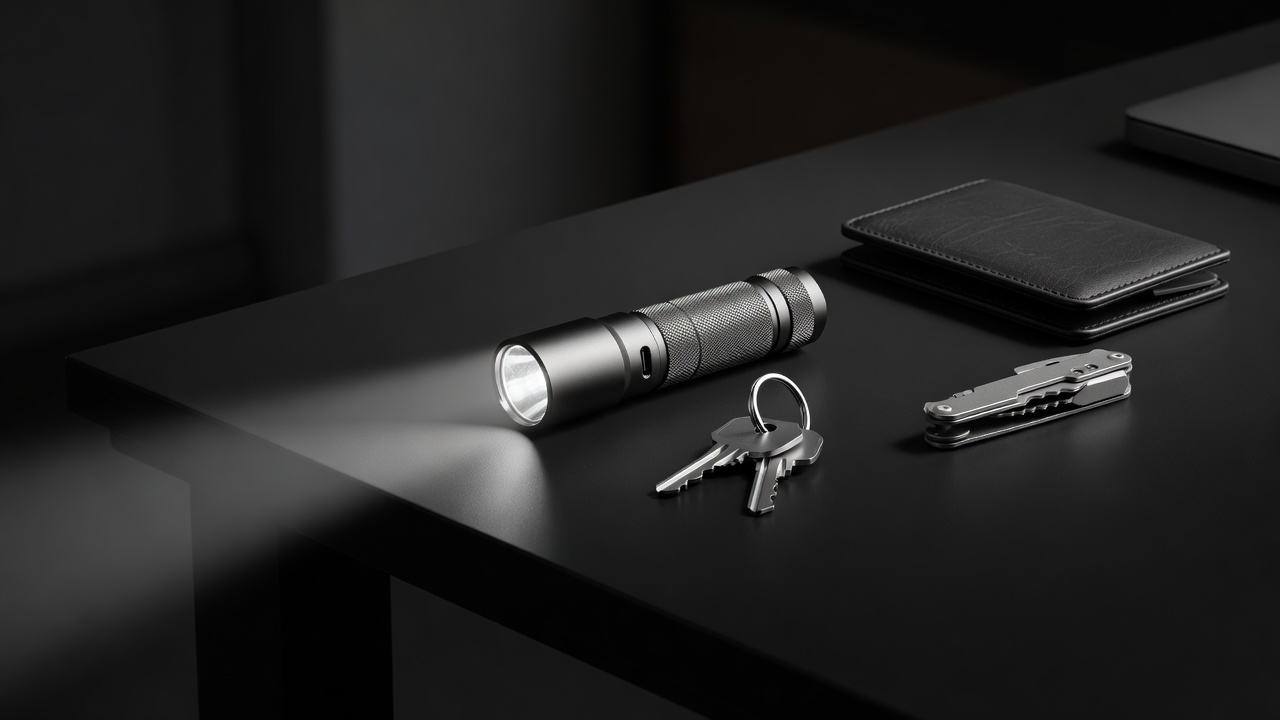
A smartphone flashlight is convenient when you need a little illumination, but it has important limitations. Phones are awkward to hold during repairs, their lights are generally designed for close-range use, and draining your phone battery may be undesirable during an emergency. A dedicated EDC Flashlight provides a compact source of light designed specifically for regular carrying, whether you’re searching under a vehicle seat, walking after dark, dealing with a power outage, working on equipment, or handling an unexpected roadside problem.
EDC stands for “everyday carry,” a category that includes practical items people keep with them regularly. The ideal everyday flashlight therefore needs to balance performance with portability. A light capable of producing extremely high output may look impressive on a specification sheet, but it becomes far less useful if it is too bulky to carry or gets excessively hot within seconds. Similarly, a tiny keychain model may disappear in a pocket but lack the runtime or beam characteristics required for longer tasks.
Choosing the right flashlight involves looking beyond maximum lumen output. Battery chemistry, beam pattern, controls, weather resistance, charging, pocket retention, low-output modes, and sustained performance can matter much more during actual use. This guide covers seven essential features and practical considerations for selecting a dependable everyday light.
What Is an EDC Flashlight?
An EDC Flashlight is a portable flashlight specifically suited to regular everyday carry.
It is generally smaller than traditional full-size flashlights and may be carried using:
- A pocket clip.
- Bag or backpack.
- Keychain.
- Belt pouch.
- Organizer.
Everyday models range from tiny rechargeable keychain lights to high-performance cylindrical flashlights with replaceable lithium-ion batteries.
The right format depends on what you expect the light to do.
Why Carry a Dedicated Flashlight?
People often underestimate how frequently targeted illumination is useful.
Common situations include:
- Looking beneath furniture.
- Reading labels in dark areas.
- Inspecting a vehicle.
- Walking at night.
- Finding items inside a bag.
- Working during an outage.
- Performing maintenance.
- Navigating a campsite.
A dedicated flashlight also allows you to preserve your phone’s battery for communication, navigation, or emergency calls.
1. Choose Useful Brightness, Not Just Maximum Lumens
Lumens describe light output, but the largest number does not automatically indicate the best EDC Flashlight.
Everyday tasks require different output levels.
Low Mode
Useful for close-range work, reading, or preserving battery power.
Medium Mode
Often appropriate for general walking and household use.
High Mode
Provides additional illumination for larger spaces or outdoor distances.
Turbo Mode
Some high-performance flashlights provide brief bursts of extreme output.
Turbo output can generate substantial heat and may step down automatically as the flashlight manages temperature and battery demand.
When comparing lights, pay attention to sustained output and runtime rather than only headline turbo lumens.
2. Consider the Beam Pattern
Two flashlights with identical lumen ratings can look dramatically different because they distribute light differently.
Flood Beam
Flood-oriented lights spread illumination across a broad area.
They are useful for:
- Indoor work.
- Campsites.
- Close-range repairs.
- General walking.
Throw Beam
Throw-oriented lights concentrate illumination into a narrower beam designed to reach farther.
Balanced Beam
Many EDC Flashlight designs combine a central hotspot with usable surrounding spill.
A balanced beam can be particularly versatile for mixed everyday tasks.
3. Select the Right Battery System
Battery choice affects size, runtime, output, charging, and long-term ownership.
Built-In Rechargeable Battery
Integrated batteries simplify charging and can support very compact designs.
The disadvantage is that the battery may be difficult or impossible for the user to replace when it eventually degrades.
Replaceable Lithium-Ion Battery
Many performance-oriented lights use rechargeable cylindrical lithium-ion cells.
These can provide strong output and allow depleted batteries to be replaced.
Only use battery types specifically approved by the flashlight manufacturer.
Standard Disposable or Rechargeable Cells
Some everyday lights use commonly available AA or AAA-format batteries.
These can be convenient when charging access is limited.
4. Look for Convenient Charging
USB charging has become increasingly common.
USB-C is particularly convenient because many users already carry compatible cables for phones, tablets, or laptops.
When evaluating charging, consider:
- Port type.
- Charging speed.
- Port protection.
- Battery-level indication.
- Whether charging is built into the flashlight.
Some lights use proprietary magnetic chargers. These can be convenient in daily use but require carrying the specific cable when traveling.
5. Prioritize Practical Controls
A flashlight should be easy to operate when you actually need it.
Common interface designs include:
Tail Switch
Positioned at the rear and easy to activate with a thumb.
Side Switch
Often provides convenient access to multiple brightness modes.
Dual-Switch Design
Some models use separate controls for immediate activation and mode selection.
A well-designed EDC Flashlight should minimize accidental activation in a pocket while allowing quick access to useful brightness levels.
6. Evaluate Durability and Weather Resistance
Everyday carry equipment is regularly dropped, scratched, exposed to dust, and occasionally caught in rain.
Many flashlights use aluminum bodies because the material balances strength, weight, and heat management.
Manufacturers may provide an IP rating describing tested protection against dust and water.
Do not interpret “water resistant” as “waterproof” without checking the specific rating and test conditions.
Impact-resistance claims should also be evaluated according to manufacturer testing.
7. Make Sure It Is Comfortable to Carry
The best-performing flashlight has limited everyday value if you consistently leave it at home.
Carry comfort depends on:
- Length.
- Diameter.
- Weight.
- Pocket clip.
- Surface texture.
- Button placement.
A slim light may disappear comfortably beside a wallet or pocketknife, while a larger model may be more suitable for carrying in a bag.
Choose according to your actual routine rather than building an imaginary survival kit.
Understanding Flashlight Runtime
Runtime specifications require context.
A flashlight advertised to run for several hours may not maintain the same output throughout that period.
Brightness can decline because of:
- Battery voltage.
- Thermal regulation.
- Programmed step-down.
- Efficiency management.
Standardized test information, where provided, can make comparisons more meaningful.
Why Flashlights Get Hot
High-output LEDs generate heat.
Compact flashlights have limited surface area for dissipating that heat, so very bright modes can become noticeably warm or hot.
Quality lights often incorporate temperature regulation that reduces output when necessary.
This is normal behavior and helps protect components.
Do not cover or leave a high-output flashlight operating unattended in a way that traps heat.
Color Temperature
White LEDs can have different color temperatures.
Cooler White
Can appear crisp and visually bright.
Neutral White
Often provides a more balanced appearance.
Warmer White
Can produce a softer visual experience.
Preference is subjective, although color temperature can influence how environments and objects appear.
Color Rendering
Color Rendering Index, or CRI, describes how accurately colors appear under a light compared with a reference source.
High-CRI flashlights can be useful for:
- Electrical work.
- Medical or first-aid tasks.
- Photography.
- Identifying colored wiring.
- Inspecting materials.
Maximum brightness and high color accuracy are different design priorities.
EDC Flashlight Size Categories
Everyday lights can roughly be divided into several sizes.
Keychain Lights
Extremely portable and suitable for short, basic tasks.
Penlights
Slim and easy to carry in shirt or tool pockets.
Compact Pocket Lights
Offer a useful balance between runtime, output, and portability.
Performance EDC Lights
Slightly larger models may provide greater sustained output and battery capacity.
Choose the smallest light that still meets your real performance requirements.
EDC Flashlight for Work
Technicians, mechanics, electricians, inspectors, healthcare professionals, and tradespeople may have specialized requirements.
Useful features may include:
- High CRI.
- Magnetic tail.
- Adjustable clip.
- Stable low modes.
- Hands-free mounting.
- Long runtime.
For professional applications, reliability and ergonomics may matter more than extreme output.
EDC Flashlight for Outdoor Use
Hikers and campers may prioritize:
- Weather resistance.
- Runtime.
- Lightweight construction.
- Replaceable batteries.
- Low-output modes.
A flashlight should complement rather than replace appropriate headlamps, navigation equipment, or other safety tools for outdoor activities.
Flashlight vs. Headlamp
These tools serve different purposes.
A flashlight offers directional control and can quickly illuminate a specific object.
A headlamp keeps both hands free.
People who regularly perform repairs, hike, or work in dark environments may benefit from carrying both.
Flashlight vs. Smartphone
A smartphone LED works well for short, close-range tasks.
A dedicated EDC Flashlight generally offers advantages such as:
- More suitable grip.
- Multiple brightness levels.
- Better beam control.
- Greater lighting-specific runtime.
- Improved weather resistance on many models.
Most importantly, it preserves phone battery life.
Safety Features to Consider
High-performance lights can produce intense brightness and considerable heat.
Useful protections may include:
- Thermal regulation.
- Low-voltage protection.
- Lockout mode.
- Battery polarity protection where applicable.
Never intentionally shine a high-output beam into someone’s eyes.
Flashlights are illumination tools, and responsible use matters.
Lithium-Ion Battery Safety
Rechargeable lithium-ion cells require proper handling.
Follow manufacturer recommendations regarding:
- Battery type.
- Charging.
- Storage.
- Replacement.
- Temperature.
Do not use visibly damaged, swollen, or incorrectly specified batteries.
For replaceable cells, use reputable products compatible with the flashlight.
Common Buying Mistakes
One common mistake is purchasing exclusively based on maximum lumen output.
Other mistakes include:
- Ignoring sustained brightness.
- Choosing an inconvenient charger.
- Buying a light too large for everyday carry.
- Overlooking low modes.
- Assuming all water resistance is identical.
- Using incompatible batteries.
A balanced specification is generally more useful than one extreme performance figure.
What to Check Before Buying
Before purchasing an EDC Flashlight, compare:
- Maximum and sustained output.
- Beam distance.
- Runtime.
- Battery type.
- Charging method.
- Dimensions.
- Weight.
- Weather rating.
- Warranty.
Also read independent testing where available, particularly for output regulation and runtime.
Maintaining an EDC Flashlight
A quality flashlight requires relatively little maintenance.
Periodically:
- Clean exterior dirt.
- Inspect charging ports.
- Check battery condition.
- Examine O-rings on relevant models.
- Test all modes.
- Follow manufacturer lubrication guidance where applicable.
If the flashlight will be stored for an extended period, follow the battery manufacturer’s storage recommendations.
Smart Flashlight Technology
Flashlights are increasingly incorporating more sophisticated electronics.
Modern features can include:
- Programmable modes.
- Electronic lockout.
- Intelligent temperature regulation.
- Battery-level displays.
- Adaptive output.
Future lights may use more advanced sensors to balance brightness, runtime, and environmental conditions automatically.
Sustainability and Everyday Flashlights
A durable rechargeable light can reduce dependence on disposable batteries when maintained properly.
However, sustainability involves more than charging.
Consider:
- Replaceable batteries.
- Repairability.
- Product lifespan.
- Efficient LEDs.
- Responsible battery recycling.
Long-lasting equipment that does not need frequent replacement can offer practical environmental benefits.
Conclusion
An EDC Flashlight should be compact enough to carry consistently while providing the brightness, runtime, beam pattern, controls, and durability required for real everyday tasks. Instead of selecting a model based solely on the highest advertised lumen figure, consider how much light it can sustain, whether its beam suits your typical environment, how easily it charges, and whether its size is genuinely comfortable in a pocket or bag. Battery safety, weather resistance, low-output modes, and an intuitive interface are equally important. The best EDC Flashlight is ultimately the one that fits naturally into your routine and remains reliable when you unexpectedly need useful illumination.
FAQs
What is an EDC Flashlight?
An EDC Flashlight is a compact portable light designed to be carried regularly for everyday tasks, emergencies, work, travel, or outdoor use.
How many lumens should an EDC Flashlight have?
There is no ideal number for everyone. Low modes are useful for close work, while higher outputs support outdoor or longer-distance illumination. Sustained performance matters more than maximum output alone.
Is USB-C charging important?
USB-C can be convenient because compatible cables are widely used, but replaceable batteries and proprietary charging systems may also work well depending on your preferences.
Are rechargeable EDC flashlights better?
Rechargeable models can be convenient and economical for frequent use. Replaceable-cell models may offer additional flexibility when immediate recharging is unavailable.
What does an IP rating mean on a flashlight?
An IP rating indicates tested protection against solids and water under specified conditions. Check the complete rating rather than relying only on general “waterproof” marketing language.
Is an EDC Flashlight better than a phone flashlight?
For dedicated illumination, an EDC Flashlight generally offers better grip, beam control, brightness options, and lighting-specific battery capacity, while preserving your phone battery for other purposes.
Feature Image Pr