
Choosing Secure Overhead Door gives College Station homeowners and businesses access to professional garage door repair, spring service, opener troubleshooting, new-door installation and commercial overhead-door solutions. A garage door is often the largest moving component on a property. Its springs, cables, tracks, rollers, hinges and opener must work together to lift and control substantial weight. When one part fails, the door can become difficult to move, trap a vehicle or create a serious injury risk. This guide explains common warning signs, professional repair options, maintenance priorities and the questions customers should ask before approving service.
What Is Secure Overhead Door?
Secure Overhead Door is a garage door company serving College Station, Bryan and surrounding communities in Texas. According to its company information, services include residential garage door repair and installation, broken-spring service, opener repair, commercial doors, hangar doors and dock levelers.
The company also advertises emergency availability for urgent door problems. Customers should confirm current response time, after-hours pricing and service coverage when calling because technician availability and travel conditions can vary.
A qualified technician should inspect the complete door system before replacing parts. A noisy door may have worn rollers, loose hardware, poor balance, track damage or opener strain. A door that will not close may involve photo-eye alignment, an obstruction, control settings or mechanical binding. Secure Overhead Door should base recommendations on the observed cause rather than the most visible symptom alone.
Why Professional Garage Door Service Matters
A sectional garage door can weigh hundreds of pounds. Springs counterbalance much of that weight, while cables transfer force and keep movement controlled. Tracks guide the rollers, and the opener moves a properly balanced door through its cycle.
The opener is not intended to compensate for a broken spring or binding door. Continuing to operate a damaged system can overload the motor, bend components or cause the door to fall unexpectedly.
Professional service helps address:
- Broken torsion or extension springs
- Frayed or displaced cables
- Bent or misaligned tracks
- Damaged rollers and hinges
- Opener failures
- Safety-reversal problems
- Weather-seal deterioration
- Panel damage
- Door-balance concerns
- Commercial access interruptions
Secure Overhead Door can diagnose these conditions with the correct tools and procedures. Homeowners should avoid adjusting springs, winding cones, bottom brackets and lift cables because these parts can remain under extreme tension.
9 Essential Services From Secure Overhead Door
A dependable garage door plan prioritises safety, restores controlled movement and addresses the cause of failure. The following services cover the most common residential and commercial concerns.
1. Complete Garage Door Safety Inspection
A thorough inspection begins with the customer’s description. Useful details include when the issue started, any impact, unusual noises, weather events and whether the door behaves differently from the wall control and remote.
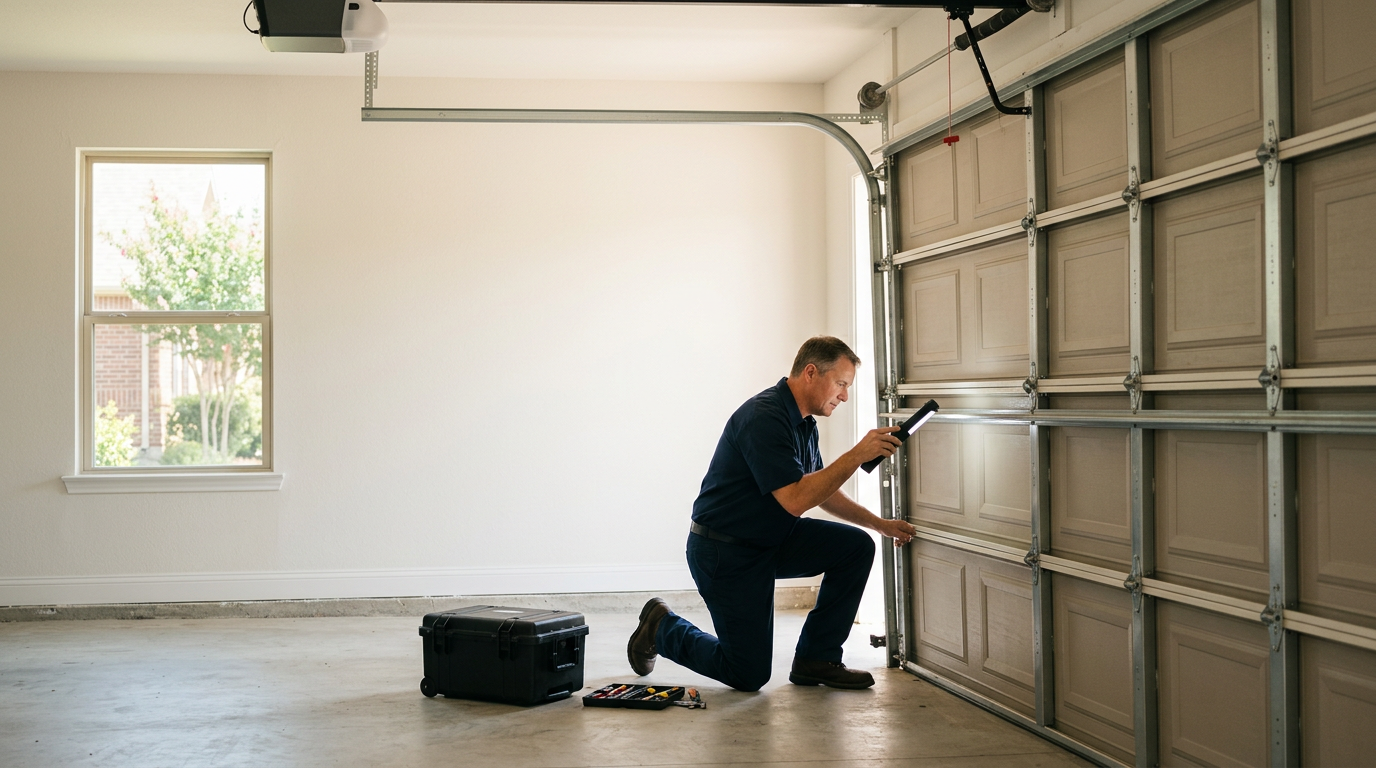
The technician may inspect springs, cables, drums, bearings, tracks, rollers, hinges, fasteners, panels, bottom fixtures, opener attachment and safety sensors. Door balance and travel should be checked only when the system is safe to operate.
Secure Overhead Door should explain which findings are urgent and which are maintenance items. A frayed cable or damaged spring system deserves different priority from a cosmetic dent.
The inspection also has limits. Concealed framing, electrical wiring and structural movement may require another trade. The technician should identify those boundaries rather than attempting work outside the garage-door scope.
2. Broken Spring Repair
Springs make the door feel manageable by counterbalancing its weight. A broken spring may produce a loud bang, leave a visible gap in a torsion spring or make the door extremely heavy.
Do not attempt to lift a heavy door manually unless emergency instructions from a qualified professional confirm it can be done safely. Do not pull the opener’s emergency release while the door is open or unstable; the door may fall.
Secure Overhead Door provides spring repair. The technician should identify spring type, door weight, cycle requirements and condition of related hardware. Springs need to be sized for the actual door, not selected only by visual similarity.
When one spring in a matched pair breaks, customers may be offered replacement of both because they have often completed similar cycles. The technician should explain the reasoning, warranty and options rather than treating the choice as automatic in every case.
3. Garage Door Opener Repair
An opener contains a motor, drive system, controls, travel settings and safety functions. A door that does not move may have an opener fault, but mechanical door problems should be ruled out first.
Symptoms can include humming, intermittent operation, remote failure, a moving trolley with no door movement, reversal, excessive vibration or lights flashing in a diagnostic pattern.
Secure Overhead Door can inspect power, controls, gears, belts or chains, rail components, sensors and door balance. The technician should not simply install a stronger opener to overcome a binding or overweight door.
Some older openers may lack modern safety features or available replacement parts. In those cases, replacement can be more practical than repair. Customers should receive compatible options based on door size, use and accessory needs.
4. Safety Sensor and Auto-Reverse Service
Modern residential openers use entrapment-protection features. Photoelectric sensors near the floor detect an obstruction in the beam, while force or travel controls can cause reversal when the door encounters resistance.
A door that closes only while the wall button is held may have a sensor alignment, wiring or obstruction issue. Dirty lenses, sunlight, damaged brackets and loose wiring can affect operation.
Secure Overhead Door should test safety reversal after relevant repairs and explain routine owner checks. Homeowners should never bypass sensors, mount them higher to avoid interference or alter force settings to push through an obstruction.
If the door fails a safety test, stop automatic operation until it is repaired. Keep children, pets and objects away from the opening.
5. Track, Roller and Cable Repair
Tracks guide the door but do not carry all of its weight. Bent tracks, loose brackets or damaged rollers can cause binding, scraping and derailment. Cables lift the door and remain under spring tension.
A cable that has jumped the drum, frayed or gone slack can leave the door crooked. Operating it may cause further damage or sudden movement.
Secure Overhead Door should secure the door before working on tracks, cables or bottom fixtures. Replacement components must match the door system and load.
Homeowners can visually observe these parts from a safe distance but should not loosen brackets or cut cables. Lubricating a damaged roller will not correct a bent stem, broken bearing or alignment problem.
6. Garage Door Panel and Full-Door Replacement
A dented panel may be cosmetic, but severe damage can affect alignment, insulation, reinforcement and opener attachment. Replacement feasibility depends on the door model, panel availability, colour and age.
One-panel replacement may be economical when the rest of the door is sound. A full replacement may provide better value when several sections are damaged, parts are unavailable, corrosion is widespread or the customer wants improved appearance and performance.
Secure Overhead Door offers garage door installation. A proposal should identify door size, construction, insulation, window design, colour, tracks, springs, hardware, opener compatibility and removal of the old door.
Do not assume the existing framing and opening are ready for every new model. Headroom, side room, back room and mounting support must be evaluated.
7. New Garage Door Installation
A new door influences appearance, security, weather resistance and daily convenience. Selection should begin with opening dimensions and site conditions.
Steel, aluminium, composite and other door constructions offer different balances of cost, weight, corrosion resistance and maintenance. Insulation can improve thermal performance and door stiffness, but the garage’s walls, ceiling and air sealing also affect overall comfort.
Secure Overhead Door should explain wind requirements, track configuration, spring system, seal package and warranty. College Station storms and heat make correct installation and weather protection important.
The completed door should move smoothly, remain balanced, seal reasonably against the opening and operate through all safety functions. Customers should receive manuals and maintenance guidance.
8. Commercial Overhead and Hangar Door Service
Commercial doors may operate more frequently and serve loading, security, storage or aircraft-access functions. Their size and use can create hazards beyond those of a standard residential door.
Service planning should consider door type, cycle frequency, controls, safety devices, access, operational downtime and traffic management. Hangar doors may involve specialised structures and drive systems.
Secure Overhead Door lists commercial and hangar-door services. Property managers should confirm experience with the exact equipment, insurance, lockout procedures, lift requirements and manufacturer parts.
A commercial door should be removed from service when it is unstable, off track or has compromised lifting components. Employees should not attempt temporary rigging to maintain operations.
9. Dock Leveler Inspection and Repair
A dock leveler bridges the gap between a loading dock and a vehicle. It is part of a material-handling system and must support rated loads while operating in coordination with restraints, doors and traffic procedures.
Warning signs include uneven movement, failure to hold position, hydraulic leakage, damaged lips, unusual noise or structural distortion. A defective leveler can create fall, crush and forklift hazards.
Secure Overhead Door offers dock-leveler service according to its website. Commercial clients should identify equipment make, model, capacity and symptoms before the appointment.
Only trained personnel should inspect components beneath a leveler, and approved maintenance supports or lockout procedures are essential. Ordinary props are not safe substitutes.
Warning Signs to Call Secure Overhead Door
Schedule professional service when you notice:
- A visible gap in a torsion spring
- A door that feels unusually heavy
- Frayed, loose or displaced cables
- A crooked or jammed door
- Rollers leaving the track
- Grinding, popping or scraping sounds
- An opener that strains or stalls
- Repeated reversal with no visible obstruction
- Safety sensors that do not function
- A door that drops rapidly
- Loose hinges or cracked panels
- Gaps that suddenly appear around the opening
- Opener attachment pulling away from the door
- Commercial doors that move unpredictably
- Hydraulic leakage at a dock leveler
Stop using the door when lifting components are damaged or movement is uncontrolled. Keep people, pets and vehicles away. If a door is partially open, do not pass beneath it.
Secure Overhead Door should be informed of the door’s position and condition so the technician can prepare for safe access.
Secure Overhead Door Spring Repair Process
Spring service is specialised because stored mechanical energy can cause serious injury.
System identification
The technician determines whether the door uses torsion, extension or another spring arrangement. Door size, weight and hardware are evaluated.
Door securing
The door and opener are isolated as needed. The technician controls tension using proper tools and procedures.
Component inspection
Cables, drums, bearings, shafts, bottom brackets and opener attachment are checked for related wear. Replacing a spring without addressing a damaged cable may leave the system unreliable.
Spring installation and balance
Correctly sized springs are installed and adjusted. The door is tested for balance through its travel.
Final safety test
Secure Overhead Door should reconnect and test the opener, travel limits and safety reversal when the system is safe.
Secure Overhead Door Opener Options
Opener selection should match the door, usage and customer priorities.
Belt-drive openers
Belt systems are often selected for quieter operation, particularly when living space is adjacent to or above the garage.
Chain-drive openers
Chain drives are common and durable but can transmit more noise and vibration when not maintained.
Wall-mount openers
Side-mounted designs free ceiling space but require compatible door hardware, side clearance and power placement.
Smart controls
Connected openers can provide remote status and alerts. They depend on network reliability, account security and compatible accessories.
Secure Overhead Door should verify lifting capacity, door balance, rail length, lighting, battery backup where desired and accessory compatibility. A powerful motor does not correct a mechanically defective door.
Repair or Replace a Garage Door?
Repair may be appropriate when damage is limited to springs, rollers, cables, hinges, an opener component or one available panel. Full replacement may be more economical when multiple sections are damaged, the door is severely corroded, hardware is obsolete or the customer wants a different performance level.
Consider:
- Structural condition
- Repair frequency
- Panel availability
- Door balance
- Opener compatibility
- Insulation goals
- Appearance
- Weather performance
- Safety features
- Warranty
Ask Secure Overhead Door for separate options when both are practical. Replacement should not be recommended solely because a door is old, and repeated repairs should not continue when the overall system is deteriorated.
Garage Door Maintenance for Texas Conditions
Heat, dust, humidity and storms can affect garage doors. Regular visual checks help identify changes before failure.
Homeowners can:
- Keep tracks free of debris without adjusting them
- Observe cables for visible damage without touching them
- Inspect hinges and rollers from a safe position
- Clean photo-eye lenses gently
- Test safety reversal according to manufacturer guidance
- Keep the threshold area clear
- Check weather seals for damage
- Listen for new noises
- Schedule professional inspection when balance changes
Use only the lubricant recommended for the door’s moving parts. Do not apply heavy grease to tracks; tracks generally guide rollers and should remain clean.
Secure Overhead Door can complete technical maintenance involving spring balance, fastener torque, bearings, cables, tracks and opener controls.
Garage Door Safety for Families
Children should never play with remotes, wall controls or moving doors. Wall controls should be mounted out of young children’s reach and where the user can see the door.
Do not race under a closing door or place hands near hinges and section joints. Pinch-resistant designs reduce some risk but do not make a moving door harmless.
Keep remotes secure. Lost transmitters should be erased from the opener and reprogrammed according to the manual. Vacation-lock features can provide additional control when away.
A garage door should not be used as the main pedestrian entrance when avoidable. Frequent walking beneath a moving door increases exposure to mechanical failure.
Commercial Preventive Maintenance
Commercial overhead doors may cycle many times each day. Planned maintenance can reduce unexpected downtime and identify wear in high-load components.
A program may include:
- Door and hardware inspection
- Spring and counterbalance checks
- Cable and roller evaluation
- Operator controls
- Safety devices
- Weather seals
- Fasteners and supports
- Dock coordination
- Service documentation
Secure Overhead Door should tailor frequency to equipment type, cycle count, environment and manufacturer guidance. One schedule does not fit every warehouse, shop or hangar.
Facility managers should train employees to report unusual noise, delayed movement and impact immediately. Damaged doors should be isolated rather than forced back into service.
How Much Does Secure Overhead Door Cost?
Garage door cost depends on door size, construction, spring system, opener type, parts, labour, access, emergency timing and commercial equipment requirements. A sensor adjustment cannot be compared with a full double-door installation or hangar-door repair.
A written estimate should identify:
- Diagnosis or service fee
- Parts and labour
- Door model and size
- Spring or hardware specifications
- Opener model and accessories
- Removal and disposal
- Electrical or framing exclusions
- Permit responsibility where applicable
- Warranty
- Payment terms
- After-hours charges
- Change-order process
Secure Overhead Door advertises estimates and financing availability. Customers considering financing should review interest, fees, promotional terms and total repayment.
Compare complete scopes rather than headline prices. One quote may include tracks, seals, disposal or reinforcement that another excludes.
Questions to Ask Secure Overhead Door
Before approving service, ask:
- What caused the failure?
- Is the door safe to operate now?
- Which parts need immediate replacement?
- Are related cables, rollers and bearings in sound condition?
- What spring specification is proposed?
- Is the opener compatible with the door?
- Does installation include new tracks and seals?
- Are framing or electrical repairs excluded?
- What warranty applies to parts and labour?
- Are emergency charges included?
- Will safety reversal be tested?
- What maintenance is recommended?
Secure Overhead Door should provide clear explanations and distinguish required safety work from optional appearance or convenience upgrades.
Common Garage Door Mistakes to Avoid
Adjusting springs without training
Springs store dangerous energy. Winding and adjustment require professional tools and procedures.
Pulling the emergency release on an open damaged door
A door with failed springs may fall when disconnected from the opener.
Forcing an off-track door
Operation can bend tracks, damage panels and cause the door to collapse.
Bypassing safety sensors
Sensors are part of the entrapment-protection system and should never be disabled.
Using the opener to lift a heavy door
The opener is designed to move a balanced door, not replace spring force.
Lubricating tracks heavily
Grease can collect debris and does not correct alignment or roller damage.
Ignoring frayed cables
Cables can fail suddenly. Stop operation and arrange service.
Standing beneath a moving door
Never walk, work or park beneath an unstable or operating door.
Preparing for a Secure Overhead Door Appointment
Before the technician arrives:
- Keep everyone away from the damaged door.
- Do not operate it repeatedly.
- Move vehicles only if the door can be made safe.
- Clear interior access without passing beneath an unstable door.
- Secure pets.
- Gather opener manuals and remote controls.
- Note any impact or storm event.
- Describe unusual noise and timing.
- Identify commercial lockout procedures.
- Do not touch springs, cables or bottom brackets.
If a vehicle is trapped, tell the dispatcher. Do not improvise lifting with jacks, ropes or helpers.
Conclusion
Secure Overhead Door supports College Station and surrounding communities with garage door repair, spring service, opener troubleshooting, new-door installation, commercial doors, hangar doors and dock levelers. Because overhead doors combine substantial weight with high-tension components, professional diagnosis and controlled repair are essential.
Property owners should stop operation when a spring breaks, a cable frays, a door comes off track or movement becomes uncontrolled. They should never bypass safety sensors, loosen bottom brackets or use the opener to lift a mechanically failed door.
Before approving work, ask Secure Overhead Door for a written scope covering the diagnosis, parts, door or opener model, related hardware, safety testing, warranty and emergency charges. Qualified service and preventive maintenance can reduce downtime, protect equipment and help the door operate more safely throughout its working life.
FAQs
1. What services does Secure Overhead Door provide?
The company lists garage door repair and installation, spring and opener service, commercial doors, hangar doors and dock-leveler work.
2. Where does Secure Overhead Door provide service?
It serves College Station, Bryan and surrounding Texas communities within its stated service region. Confirm availability for the specific address.
3. Does Secure Overhead Door offer emergency service?
The company advertises emergency availability. Confirm current response time and after-hours charges when scheduling urgent service.
4. Can I open a garage door with a broken spring?
A broken spring can make the door dangerously heavy. Avoid operation and ask a qualified technician how to secure or access the garage safely.
5. Why does my garage door close and then reverse?
Possible causes include an obstruction, sensor issue, incorrect travel settings or mechanical resistance. A technician should inspect the safety and door systems.
6. Should both garage door springs be replaced together?
Matched springs often have similar cycle history, so replacing both may be recommended. The best choice depends on system design, condition, warranty and cost.