
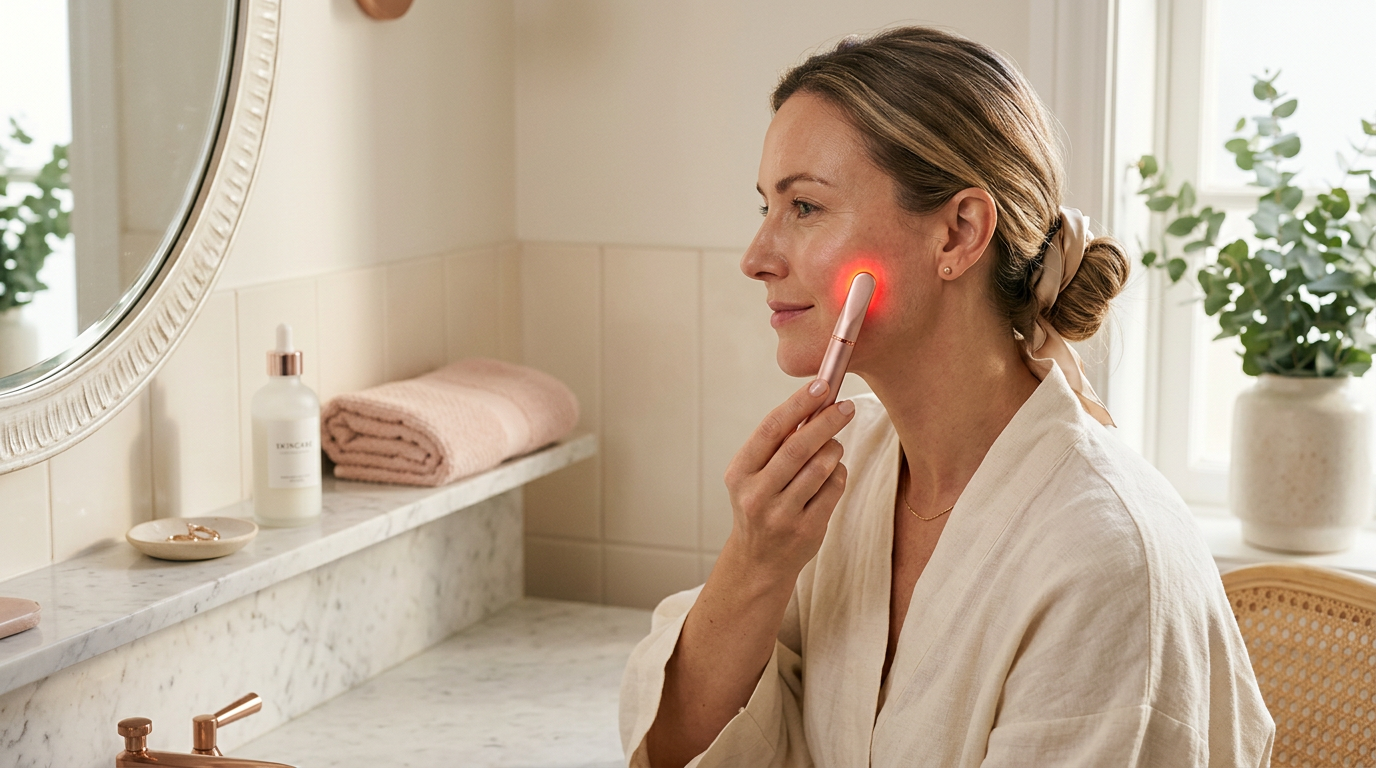
A red light wand is a compact skincare device designed to deliver targeted red or near-infrared light to the face and other manufacturer-approved areas. These handheld tools appeal to people who want a convenient alternative to a full-face LED mask or a large light panel. However, device quality, treatment parameters, technique and consistency can influence the experience. This evidence-aware guide explains how red-light skincare works, which benefits are plausible, how to compare devices, what safety precautions matter and why realistic expectations are essential.
What Is a Red Light Wand?
A red light wand is a handheld device fitted with light-emitting diodes, or LEDs, that produce specific wavelengths of visible red light and, in some models, near-infrared light. The user moves or holds the treatment head over designated areas for the time specified by the manufacturer.
Red-light treatment is often described as photobiomodulation or low-level light therapy. Unlike ultraviolet radiation, red and near-infrared light do not tan the skin. They also differ from intense pulsed light, ablative lasers, radiofrequency and ultrasound devices. Each technology uses a different form of energy and has a distinct risk and evidence profile.
Some red light wand products add features such as gentle warmth, vibration, facial massage or microcurrent-like technology. These functions should be evaluated separately. A device containing several modalities does not automatically perform better, and each feature may have its own contraindications and operating instructions.
At-home devices are typically less powerful than professional systems used in dermatology settings. That does not make them useless, but it means results may be gradual and depend on regular use.
How Does a Red Light Wand Work?
Red and near-infrared wavelengths can interact with light-sensitive components in cells. Researchers continue to study the exact mechanisms, but the process may influence cellular energy pathways, inflammation and tissue activity. In skincare, red-light devices are commonly marketed for supporting smoother-looking texture, a more even appearance and reduced visibility of fine lines.
The delivered dose depends on several variables:
- Wavelength: The colour or band of light emitted, measured in nanometres.
- Irradiance: The amount of optical power reaching an area of skin.
- Treatment time: How long the device is applied.
- Distance: How close the LEDs are to the skin.
- Coverage: Whether the treatment head reaches the full intended area evenly.
- Frequency: How often sessions are completed.
- Consistency: Whether the recommended routine is maintained over time.
A red light wand should therefore be used exactly as instructed. Longer or more frequent treatment is not necessarily better. Photobiomodulation is dose-dependent, and increasing exposure beyond the tested protocol may add irritation without improving results.
9 Potential Benefits of Using a Red Light Wand
The evidence for red-light skincare is promising for some cosmetic concerns, but results vary by device and individual. The most responsible way to discuss benefits is to separate plausible, modest improvements from dramatic marketing claims.
1. Targeted Treatment of Small Areas
A red light wand allows the user to focus on areas such as the forehead, cheeks, jawline or around the mouth, provided those areas are approved in the instructions. This precision can be useful for someone who does not want to wear a mask or expose the entire face during every session.
Targeting also has a practical disadvantage: the user must move the device methodically to achieve even coverage. Skipping sections or changing speed can create an inconsistent dose. A treatment routine should follow a simple pattern so each area receives similar attention.
A handheld design may suit users who want to concentrate on one or two visible concerns. Someone seeking full-face treatment, however, may find a mask more convenient because it covers a larger area simultaneously.
2. Support for Smoother-Looking Skin
Some studies of red-light LED devices indicate modest improvements in skin texture and roughness with consistent use. The response is not equivalent to resurfacing procedures, and a red light wand should not be expected to erase deep lines, scars or substantial textural change.
Visible improvements can be influenced by hydration, lighting, camera settings, skincare products and natural fluctuations. Users who want to track results should take photographs under the same light, distance, angle and facial expression every few weeks rather than comparing daily mirror impressions.
A gentle cleanser, suitable moisturiser and daily sun protection remain the foundation of a texture-focused routine. Light treatment is an adjunct, not a replacement for those essentials.
3. Reduction in the Appearance of Fine Lines
Red-light photobiomodulation has been studied for photoageing and fine lines. Some research suggests that properly designed devices used consistently can produce subtle to noticeable cosmetic improvement for some people.
The key word is subtle. A red light wand cannot reproduce the effects of injectable treatments, surgery, ablative resurfacing or other clinician-performed procedures. It is better viewed as a low-intensity home-care option for people willing to follow a routine and wait for gradual change.
Deep wrinkles, marked laxity or rapidly changing skin should be assessed by a dermatologist. A qualified clinician can explain which treatments are supported for the specific concern and whether a home device is likely to provide meaningful value.
4. A More Radiant Appearance
Users often describe their skin as looking refreshed or radiant after adding LED treatment. That impression may be related to several factors, including temporary circulation changes, hydration from a conductive serum, massage, or a consistent skincare routine established around device use.
Radiance is subjective and difficult to measure. Marketing photographs may exaggerate it through lighting, makeup and image processing. A red light wand should not be purchased solely on the strength of dramatic before-and-after images.
Look for controlled product testing that uses consistent photography and clearly reports the number of participants, treatment schedule, study duration and outcome measures.
5. Non-Invasive At-Home Skincare
A red light wand does not puncture the skin or intentionally remove surface tissue. Most home LED devices require no recovery period when used correctly, making them appealing to people who want a low-disruption routine.
Non-invasive does not mean risk-free. Temporary redness, dryness, discomfort, headache or irritation can occur. Other technologies built into a multi-function wand may create additional sensations or precautions.
Stop using the device if the skin becomes painful, blistered, persistently red, unusually darkened or otherwise concerning. Seek medical advice when symptoms are significant or do not resolve.
6. Portability and Convenient Storage
Compared with a full panel, a red light wand is easy to store and transport. It may fit into a bathroom drawer, travel case or skincare organiser. Rechargeable models reduce dependence on a power outlet during use.
Portability only matters if the device is used consistently. Before buying, consider charging time, battery life, treatment duration and whether the wand can be cleaned easily. A complicated routine may be abandoned even when the product performs as designed.
When travelling, protect the treatment head from scratches and contamination. Follow airline rules for rechargeable batteries and do not store the device in extreme heat, direct sun or a damp environment.
7. Compatibility With a Simple Skincare Routine
Many people can incorporate a red light wand after cleansing and before or alongside a compatible hydrating product, depending on the manufacturer’s instructions. Some devices are designed to glide over a water-based serum, while others should be used on clean, dry skin.
Do not assume every skincare ingredient is compatible. Photosensitising medications and certain topical treatments may require caution. Strong acids, retinoids or irritating products can also make skin more reactive, even if they do not directly interact with red light.
A dermatologist or prescribing clinician should review the routine if the user takes medication associated with light sensitivity, has a photosensitive disorder, or is receiving treatment for a skin condition.
8. A Relaxing Facial-Massage Experience
Some wands include vibration, warmth or a smooth treatment head that creates a massage-like experience. This can make the routine enjoyable and may encourage consistent use.
Massage-related effects should not be confused with the biological effects of red light. Temporary reduction in puffiness may result from movement and positioning rather than permanent structural change. Excess pressure can irritate sensitive skin, worsen inflammation or cause discomfort around bony areas.
Use a red light wand with gentle contact. Do not press hard, drag across dry skin when glide is required, or repeatedly treat one spot because it feels relaxing.
9. A Gradual, Trackable Skincare Habit
At-home devices can encourage people to pay closer attention to their skin. A structured schedule, consistent photographs and a simple routine may make it easier to notice whether the investment is worthwhile.
Track only a few outcomes, such as texture, fine-line visibility, redness or ease of use. Avoid changing multiple products at the same time, as doing so makes it difficult to identify what caused improvement or irritation.
A reasonable trial should follow the device’s recommended schedule and evaluation period. If a red light wand produces no meaningful change after consistent, correct use, review the return policy and consider whether continued treatment is justified.
Red Light Wand Wavelengths Explained
Wavelength is often treated as a mark of quality, but a number alone does not establish effectiveness. Dose, distance, treatment time and engineering also matter.
Visible red light
Red-light skincare devices commonly operate within a visible red range. Research often discusses wavelengths around the low-to-mid 600-nanometre region, although consumer products vary. Visible red light generally acts more superficially than near-infrared light.
Near-infrared light
Near-infrared wavelengths are not visible to the human eye and may penetrate more deeply than visible red light. Some devices combine both ranges. The absence of visible brightness does not mean a near-infrared LED is inactive.
Blue light is different
Blue light is used in some acne-oriented devices because it interacts differently with skin and acne-associated bacteria. A red light wand that emits only red light should not be assumed to provide the same function as a combined blue-and-red device.
Wavelength claims should be supported by clear technical specifications. Be cautious when a seller uses terms such as “medical grade” without explaining what standard, clearance or evidence supports the phrase.
How to Choose the Best Red Light Wand
The best device is one that matches the intended use, has transparent specifications and can be used safely and consistently.
Check regulatory language carefully
In the United States, “FDA cleared,” “FDA registered” and “FDA approved” do not mean the same thing. Clearance commonly relates to a specific device and intended use. A company’s facility registration alone does not establish that a product was reviewed for effectiveness.
Verify the exact model and intended use rather than relying on a logo or vague statement. Regulatory status also does not guarantee that every customer will achieve the advertised result.
Review the intended use
A red light wand may be marketed for cosmetic signs of ageing, acne-related concerns or general wellness. Make sure the stated purpose matches the reason for buying it. Do not use a cosmetic device to diagnose or treat a medical condition.
Look for transparent specifications
Useful information includes wavelength, treatment time, treatment distance, power source, warranty, contraindications, eye-safety instructions and cleaning requirements. Irradiance or dose information can help informed comparison, although consumers should not attempt to redesign the protocol themselves.
Consider treatment-head size
A small head offers precision but requires more time for full-face coverage. A larger head treats more surface area but may be harder to position around facial contours. Choose based on the actual treatment area.
Evaluate design and ergonomics
The red light wand should be comfortable to hold, simple to control and easy to move evenly. Check weight, handle angle, button placement, charging method and whether the device turns off automatically.
Assess the warranty and return policy
Results take time, so the return period should allow a meaningful trial when possible. Review exclusions, return shipping, hygiene restrictions and warranty coverage before purchase.
Treat reviews as supporting evidence, not proof
Reviews can reveal usability, charging, durability and customer-service patterns. They cannot establish clinical effectiveness. Be cautious with incentivised reviews and photographs taken under different conditions.
How to Use a Red Light Wand Safely
Always prioritise the instructions supplied with the specific device. The following steps are general and should not override the manual.
Step 1: Read the complete manual
Review treatment time, approved areas, frequency, charging, cleaning, eye protection, contraindications and warning symbols. Multi-function products may have separate instructions for light, warmth, vibration or electrical current.
Step 2: Clean the skin as directed
Remove makeup, sunscreen and surface debris. Use the device on dry skin or with a compatible product according to the manufacturer. Oil-based products may interfere with devices designed around galvanic current or conductivity.
Step 3: Test cautiously
If the manufacturer recommends a patch or sensitivity test, complete it before a full session. People with reactive skin should be especially cautious when combining the wand with new skincare products.
Step 4: Follow the treatment pattern
Move the red light wand at the instructed speed or hold it in place for the stated time. Use a consistent route across the face to avoid missing or repeatedly treating areas.
Step 5: Protect the eyes
Do not stare into LEDs. Use eye protection when the manual requires it, and avoid applying the device directly over closed eyelids unless that use is explicitly approved.
Step 6: Finish with a simple routine
Apply compatible moisturiser and daytime sun protection as appropriate. A red light wand does not replace sunscreen and does not prevent ultraviolet damage.
Step 7: Clean and store the device
Disconnect or switch off the wand, then clean the treatment surface as directed. Do not submerge a device unless it is specifically rated for that use. Store it dry and protected.
Red Light Wand Safety and Contraindications
At-home red-light devices are often well tolerated in the short term, but long-term evidence remains limited. Individual medical history matters.
Consult a healthcare professional before use if you:
- Have lupus or another photosensitive condition
- Take a medication that can increase light sensitivity
- Use a prescription topical that affects skin sensitivity
- Have a history of unusual reactions to light
- Are pregnant or breastfeeding and the manual advises against use
- Have active cancer, suspicious lesions or an undiagnosed skin change in the treatment area
- Recently had a facial procedure, peel, laser treatment, injection or surgery
- Have an implanted electronic or metal device and the wand includes electrical current or heat
- Have epilepsy triggered by flashing light
- Are treating a child or adolescent
The list is not exhaustive. Device-specific contraindications take priority.
Do not use a red light wand over open wounds, active infection, severe irritation or areas without normal sensation unless a clinician and the manufacturer confirm that it is appropriate. Do not share a device without proper cleaning.
Common Red Light Wand Mistakes
Using it for too long
More exposure does not guarantee faster improvement. Follow the tested schedule.
Treating inconsistently
Occasional use may not reproduce results seen in studies or manufacturer testing. Choose a routine you can realistically maintain.
Skipping sunscreen
A red light wand does not block ultraviolet radiation. Daily sun protection remains central to managing visible photoageing.
Expecting dramatic lifting
LED treatment may support modest cosmetic improvement, but it cannot remove substantial skin laxity or replace surgery.
Combining too many active products
Using strong retinoids, exfoliating acids, scrubs and a new device simultaneously can increase irritation and make the cause difficult to identify.
Ignoring eye instructions
LED brightness can be uncomfortable and may be unsafe when used improperly. Follow all eye-protection requirements.
Buying on influencer claims alone
Celebrity use and social-media popularity do not establish device quality. Evaluate specifications, clearance, evidence, warranty and instructions.
Failing to clean the treatment head
Oil, makeup and skincare residue can accumulate. Clean the wand according to the manual after use.
Red Light Wand vs. LED Mask
A red light wand provides targeted treatment and is generally compact. It may work well for users focused on specific areas or those who dislike wearing a mask. The trade-off is that treatment can take longer and coverage depends on technique.
An LED mask treats a larger area at once and may deliver more consistent facial coverage. However, fit, comfort, eye design, weight, portability and cost vary. A mask that does not sit at the intended distance may not deliver light uniformly.
Neither format is automatically superior. The better choice is the device with credible specifications, suitable clearance, clear instructions and a routine the buyer will follow.
Red Light Wand vs. Professional Treatment
Professional red-light systems may deliver different wavelengths, irradiance and treatment control. A dermatologist can also evaluate the skin concern, rule out medical conditions and combine treatment with other evidence-based options.
A home red light wand offers convenience and lower per-session effort after purchase. It may be suitable for modest cosmetic goals, maintenance or users who prefer gradual treatment.
Professional care is more appropriate for uncertain diagnoses, severe acne, rapidly changing pigmentation, bleeding lesions, significant scarring, substantial laxity or concerns that do not respond to routine skincare. A device should never delay evaluation of a suspicious mole or persistent rash.
How Long Does a Red Light Wand Take to Show Results?
There is no universal timeline. Results depend on the device, dose, skin concern, age, baseline condition, adherence and evaluation method. Some people notice a temporary glow or smoother feel early, while structural changes associated with fine lines would generally require repeated use over a longer period.
Use the manufacturer’s trial period as a starting point, but remain sceptical of guaranteed results within days. Take standardised photographs and avoid inspecting the skin under changing light.
If irritation develops, stop rather than pushing through to meet a schedule. If the device appears ineffective after a consistent trial, reassess the technique, specifications and whether the cosmetic goal is realistic.
Building a Skincare Routine Around a Red Light Wand
A simple routine makes it easier to tolerate the device and identify its effects.
Morning
- Use a gentle cleanser or rinse as appropriate.
- Apply a moisturiser suited to the skin type.
- Use broad-spectrum sunscreen.
Device session
- Follow the manual regarding clean, dry skin or compatible serum.
- Complete only the recommended treatment time.
- Avoid unapproved areas.
- Clean the device afterward.
Evening
- Remove makeup and sunscreen gently.
- Use prescribed or evidence-based skincare as tolerated.
- Avoid introducing several new actives at once.
- Apply moisturiser to support the skin barrier.
People using prescription acne, pigmentation or anti-ageing treatment should ask the prescriber how to schedule the red light wand.
Conclusion
A red light wand can be a convenient addition to an at-home skincare routine for people seeking targeted, gradual cosmetic support. Research on red-light photobiomodulation suggests potential for modest improvements in fine lines, texture and overall appearance when an appropriately designed device is used consistently.
The product should not be treated as a miracle tool or a replacement for sunscreen, medical diagnosis or professional care. Compare wavelengths, intended use, regulatory language, treatment instructions, ergonomics, warranty and safety guidance before buying. Use the red light wand exactly as directed, protect the eyes when required, keep the device clean and stop if concerning irritation occurs.
Realistic expectations are the key to satisfaction. A high-quality red light wand may support a well-designed skincare routine, but the fundamentals—sun protection, gentle cleansing, moisturising and appropriate dermatological care—remain more important than any single beauty device.
FAQs
1. What does a red light wand do for the skin?
It delivers targeted red or near-infrared light that may support modest improvements in fine lines, texture and overall skin appearance with consistent use.
2. How often should I use a red light wand?
Follow the exact schedule in the device manual. Recommended frequency differs by model, and using it more often does not guarantee better results.
3. Is a red light wand safe for all skin types?
Many people tolerate home LED devices, but they are not appropriate for everyone. Consult a dermatologist if you have sensitive skin, darker skin concerns or a medical condition.
4. Can I use retinol with a red light wand?
Compatibility depends on the product, skin tolerance and device instructions. Ask a dermatologist or prescriber if retinol causes sensitivity or is prescription strength.
5. Does a red light wand replace sunscreen?
No. Red-light treatment does not protect against ultraviolet radiation. Broad-spectrum sunscreen remains essential for preventing UV-related skin damage.
6. Is a red light wand better than an LED mask?
A wand offers precision and portability, while a mask provides broader, more uniform coverage. The best format depends on treatment goals, device quality and routine preferences.