

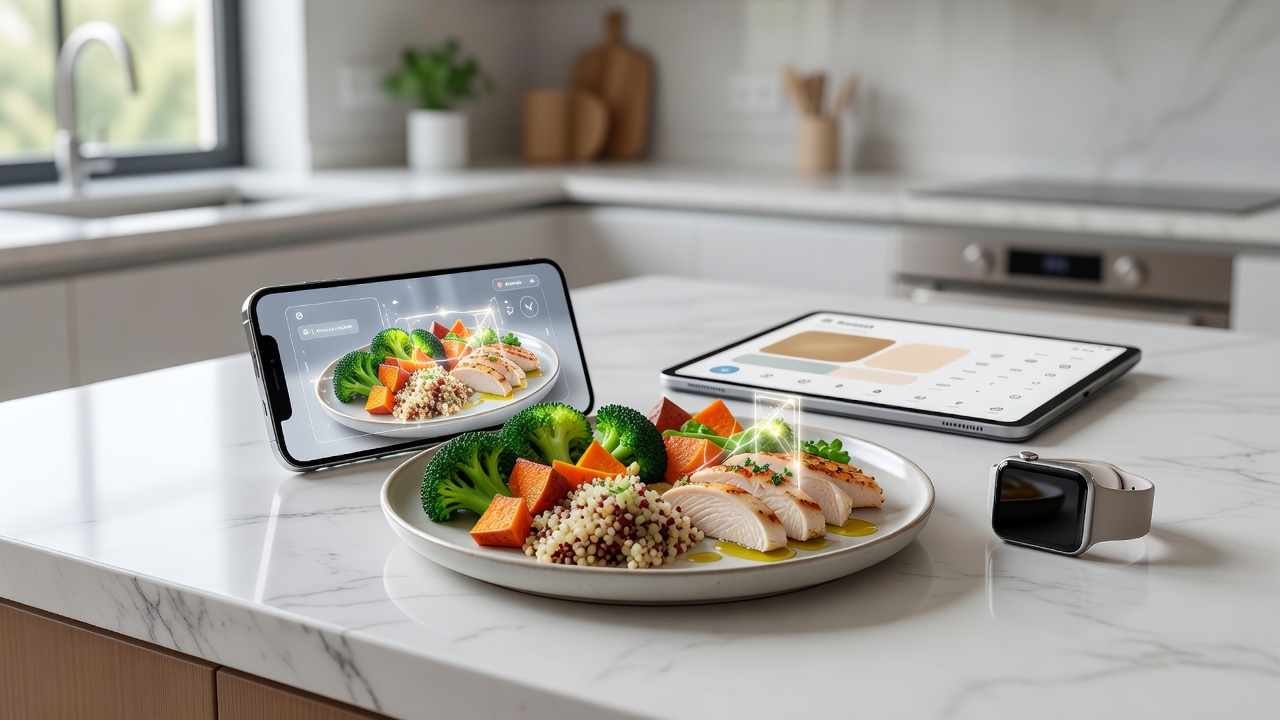
Tracking nutrition used to mean manually searching food databases, weighing ingredients, and entering every meal one item at a time. Artificial intelligence is making that process considerably easier. Some apps can now recognize meals from photographs, interpret natural-language food descriptions, suggest meal plans, identify nutritional patterns, and turn complicated food logs into understandable insights. The Best AI Nutrition Apps combine these conveniences with reliable food databases, transparent methodology, practical goal setting, and interfaces people can realistically use every day.
AI does not make nutrition tracking perfectly accurate. Estimating portions from a photograph is difficult, restaurant recipes vary, and two visually identical meals can contain very different quantities of oil, sauces, or ingredients. Personalized recommendations are also only as useful as the information behind them. People managing diabetes, kidney disease, eating disorders, pregnancy, food allergies, or other medical concerns should not substitute an AI application for individualized advice from an appropriately qualified healthcare professional or registered dietitian.
For everyone else, nutrition apps can be valuable tools for understanding eating patterns. The key is choosing technology that supports sustainable habits instead of obsessing over a supposedly perfect diet. This guide covers 10 noteworthy types and examples of AI-assisted nutrition platforms, the features that matter, privacy considerations, and how to evaluate nutrition recommendations critically.
Note: App features, subscriptions, AI functionality, geographic availability, and pricing change frequently. Verify current capabilities in the official app stores and developer documentation before subscribing.
What Are the Best AI Nutrition Apps?
The Best AI Nutrition Apps use artificial intelligence or machine-learning capabilities to simplify one or more aspects of nutrition management.
Depending on the application, AI may support:
- Food photo recognition.
- Automatic meal logging.
- Portion estimation.
- Natural-language input.
- Meal recommendations.
- Nutritional pattern analysis.
- Personalized coaching.
- Recipe generation.
Not every application marketed as “AI-powered” uses AI extensively. Some traditional calorie trackers simply add an AI chatbot or photo-recognition feature to an existing food database.
That does not necessarily make them less useful. The quality of the entire application matters more than the AI label.
How AI Nutrition Apps Work
Different applications use different technical approaches.
Computer Vision
Photo-based trackers analyze images to identify foods and estimate portions.
Natural Language Processing
Users can describe meals conversationally, such as “two scrambled eggs, whole-grain toast and half an avocado,” and the app attempts to convert the description into structured nutrition data.
Recommendation Systems
AI can analyze logged foods, goals, and preferences to suggest meals or identify nutritional patterns.
Generative AI
Some platforms use generative models to create meal ideas, explain nutritional information, or answer food-related questions.
Human review remains important because AI can misunderstand foods or generate inaccurate health advice.
1. MyFitnessPal
MyFitnessPal has long been known for calorie and macronutrient tracking and has continued introducing technology intended to make meal logging more convenient.
Its established food database and broad tracking ecosystem can appeal to users who want detailed nutrition records.
Useful capabilities may include:
- Food logging.
- Barcode scanning.
- Macro tracking.
- Meal analysis.
- Connected fitness integrations.
AI-assisted functionality and plan availability can vary, so check the current version.
For people who value an extensive database and established tracking system, it remains an option worth comparing among the Best AI Nutrition Apps.
2. Foodvisor
Foodvisor focuses heavily on simplifying food tracking through visual recognition.
Users can photograph a meal, and the platform attempts to identify foods and estimate nutritional information.
This approach can reduce manual logging, particularly for simple meals with clearly visible ingredients.
However, photographic estimation has limitations.
A camera cannot reliably determine every hidden ingredient or exact quantity, especially in mixed dishes.
Treat photo-generated values as estimates and correct obvious recognition errors.
3. SnapCalorie
SnapCalorie is built around using photographs to estimate the nutritional characteristics of meals.
Its appeal is straightforward: instead of manually entering each ingredient, users capture what they are eating and allow image-analysis technology to assist with logging.
It may appeal to people who dislike traditional manual calorie tracking.
As with any image-based system, accuracy can vary based on:
- Lighting.
- Portion visibility.
- Mixed foods.
- Hidden ingredients.
- Sauces and oils.
Users should view convenience and precision as separate considerations.
4. Cal AI
Cal AI represents the newer generation of nutrition trackers emphasizing AI-assisted food recognition and simplified calorie logging.
Users may be able to photograph meals and receive estimated calorie and macronutrient information.
This type of interface is particularly attractive to people who stop using conventional food trackers because manual entry takes too much time.
Before subscribing, evaluate the current:
- Food-recognition performance.
- Subscription terms.
- Editing options.
- Privacy policy.
- Supported goals.
An app should make it easy to correct incorrect AI estimates.
5. YAZIO
YAZIO combines calorie tracking, meal planning, fasting-related features, recipes, and personalized insights within a broader nutrition platform.
Its structured interface may appeal to users who want more than a simple food-photo analyzer.
When evaluating it against the Best AI Nutrition Apps, consider whether its particular combination of automation and traditional tracking matches your goals.
Some users want precise food logs; others primarily want better meal organization.
The best application depends on which behavior you are actually trying to change.
6. Lifesum
Lifesum combines food tracking with meal planning and broader healthy-eating guidance.
Rather than concentrating exclusively on calorie totals, it can help users examine eating patterns and organize meals around selected goals.
Features may include:
- Meal logging.
- Nutrition tracking.
- Recipe ideas.
- Dietary preferences.
- Personalized feedback.
Current AI-driven functionality should be verified in the latest version because applications regularly change features and subscription tiers.
7. Cronometer
Cronometer is well known among users interested in detailed micronutrient tracking.
Its strength has traditionally been depth rather than flashy automation.
It can track nutrients beyond calories and basic macros, which may appeal to people who want a more comprehensive nutritional view.
This makes it useful in a comparison of the Best AI Nutrition Apps even when another application offers more aggressive AI branding.
Automation should not overshadow data quality.
Users with clinical dietary requirements should still work with qualified professionals rather than independently interpreting detailed nutrient data as medical guidance.
8. MacroFactor
MacroFactor is designed around nutrition and weight-management tracking with adaptive calculations based on user data.
Its data-driven approach can appeal to users who want structured energy and macronutrient management.
Rather than assuming static estimates remain accurate indefinitely, adaptive systems can use logged trends to refine certain calculations over time.
The effectiveness of these features depends heavily on consistent and reasonably accurate input.
It is particularly relevant for users who prefer analytical tracking rather than photo-first meal logging.
9. Healthify
Healthify has developed nutrition, fitness, and coaching services and has incorporated AI-oriented features into parts of its platform.
Depending on region and subscription level, features may combine food logging with personalized guidance and human coaching.
This hybrid model highlights an important direction for nutrition technology: AI does not necessarily need to replace professionals.
Instead, automation can organize routine data while qualified people provide context for more complicated needs.
Check current regional availability and service details before subscribing.
10. AI-Integrated Meal Planning Apps
The final category among the Best AI Nutrition Apps is not one single product but a rapidly expanding group of AI-first meal planning platforms.
These tools may generate meal ideas based on:
- Dietary preferences.
- Available ingredients.
- Cooking time.
- Allergies entered by the user.
- Nutrition goals.
- Household size.
Generative meal planning can reduce decision fatigue, but recipes and nutrition estimates should be reviewed carefully.
For serious allergies, never assume AI-generated recipes are automatically safe. Ingredient labels and qualified medical guidance remain essential.
How to Compare the Best AI Nutrition Apps
The ideal application depends on your primary objective.
Ask what you actually need.
Easier Food Logging
Prioritize photo recognition, barcode scanning, saved meals, and voice or natural-language entry.
Detailed Nutrition Data
Look for comprehensive food databases and micronutrient tracking.
Meal Planning
Evaluate recipes, grocery organization, dietary preferences, and customization.
Weight Management
Consider trend analysis, sustainable goal setting, and how the app handles changes over time.
An app packed with features you never use is less valuable than a simpler tool that becomes part of your routine.
Photo Recognition Accuracy
Photo-based food tracking is impressive, but it should not be confused with laboratory measurement.
Imagine two identical-looking bowls of pasta. One may contain significantly more olive oil, cheese, or sauce than the other.
A photograph alone may not reveal that difference.
Users who require greater accuracy can improve estimates by:
- Correcting recognized ingredients.
- Entering known quantities.
- Checking package labels.
- Saving frequently eaten recipes.
AI should reduce logging work, not prevent users from correcting the record.
AI Nutrition Apps and Personalized Recommendations
“Personalized” is a widely used marketing term.
A recommendation based on age, height, weight, and an app questionnaire is personalized in one sense, but it is not equivalent to a clinical nutrition assessment.
Qualified professionals may consider additional factors such as:
- Medical history.
- Laboratory data.
- Medications.
- Eating behaviors.
- Cultural preferences.
- Clinical symptoms.
This distinction is particularly important when health conditions are involved.
Food Database Quality
AI cannot compensate for a poor underlying database.
When comparing the Best AI Nutrition Apps, look at how food information is sourced.
User-generated food entries can provide broad coverage but may include errors.
Curated or verified database entries can improve reliability, although no database is perfect.
For packaged products, compare app values with the actual nutrition label when accuracy matters.
Privacy and Nutrition Data
Food logs can reveal surprisingly personal information.
Combined with body weight, health goals, exercise data, and other information, nutrition applications may process sensitive personal data.
Before subscribing, review:
- What information is collected.
- Why it is collected.
- Data retention.
- Third-party sharing.
- Account deletion options.
- Advertising practices.
Health-related data does not automatically receive identical legal protections across every app or jurisdiction.
Nutrition Apps and Eating Disorders
Detailed calorie and weight tracking can be unhelpful or harmful for some people with current or previous eating disorders.
Warning signs may include becoming increasingly anxious about food numbers, avoiding social meals because they cannot be precisely logged, or feeling compelled to compensate for small deviations from targets.
People with eating-disorder concerns should seek guidance from qualified healthcare professionals.
The most advanced tracking technology is not necessarily the healthiest tool for every individual.
Can AI Create a Healthy Meal Plan?
AI can generate meal ideas quickly, but “healthy” is context-dependent.
A suitable diet varies according to:
- Age.
- Health.
- Allergies.
- Culture.
- Preferences.
- Energy needs.
- Medical conditions.
Generated meal plans should therefore be treated as suggestions rather than individualized medical nutrition therapy.
Best AI Nutrition Apps for Athletes
Athletes may care about:
- Energy intake.
- Carbohydrates.
- Protein.
- Hydration.
- Meal timing.
Training volume and competition demands can make generic recommendations inadequate.
Apps may help track patterns, but competitive athletes can benefit from guidance from qualified sports dietitians when nutrition significantly affects performance.
AI Nutrition Apps for Weight Loss
Nutrition apps can support weight-management behaviors by making intake patterns more visible.
However, they should avoid promising guaranteed or extremely rapid outcomes.
Body weight is influenced by numerous factors, and appropriate weight management should prioritize sustainable health rather than extreme restriction.
People using medications or managing health conditions should discuss weight goals with their healthcare professionals.
Free vs. Paid Nutrition Apps
Many applications offer basic free functionality alongside premium subscriptions.
Paid plans may unlock:
- Photo recognition.
- Advanced analytics.
- Personalized meal plans.
- Deeper nutrient data.
- AI coaching.
Before paying annually, consider testing the application long enough to determine whether its workflow actually fits your habits.
Also review renewal and cancellation terms.
Common Mistakes When Using an AI Nutrition App
One mistake is assuming every generated number is precise.
Other common problems include:
- Logging inconsistently while expecting precise analysis.
- Ignoring hidden cooking ingredients.
- Treating AI guidance as medical advice.
- Focusing excessively on daily fluctuations.
- Choosing an app solely because of AI marketing.
Use trends as information rather than treating every estimate as an exact measurement.
AI and the Future of Nutrition Tracking
The next generation of nutrition software will likely combine multiple data sources.
Future systems may integrate:
- Meal images.
- Wearables.
- Continuous health data.
- Grocery purchases.
- Meal planning.
- Voice input.
This could make tracking substantially easier.
At the same time, increased personalization makes privacy, transparency, clinical validation, and responsible recommendations even more important.
Which of the Best AI Nutrition Apps Should You Choose?
Choose based on the problem you actually want to solve.
If manual logging is the biggest obstacle, prioritize photo-based tools.
If detailed nutrient analysis matters, consider platforms with stronger database depth.
If you struggle with meal decisions, an AI meal-planning application may be more useful.
Before committing, evaluate:
- Ease of use.
- Data quality.
- Editing controls.
- Privacy.
- Subscription cost.
- Integration with devices you already use.
The best nutrition app is often the one you can use consistently without allowing tracking to dominate your relationship with food.
Conclusion
The Best AI Nutrition Apps can make food tracking, meal planning, and nutritional analysis faster and more approachable by using technologies such as computer vision, natural-language processing, adaptive algorithms, and generative AI. Platforms including MyFitnessPal, Foodvisor, SnapCalorie, Cal AI, YAZIO, Lifesum, Cronometer, MacroFactor, Healthify, and emerging AI meal planners serve different priorities, so no single application is best for everyone. Photo recognition should be treated as estimation rather than perfect measurement, and personalized AI suggestions are not substitutes for clinical nutrition care. By comparing database quality, privacy policies, correction tools, subscription costs, and the features you will genuinely use, you can choose an app that supports informed eating habits without placing unnecessary trust in automation.
FAQs
What are the Best AI Nutrition Apps?
The Best AI Nutrition Apps include a mix of established nutrition trackers and newer AI-first tools, such as MyFitnessPal, Foodvisor, SnapCalorie, Cal AI, YAZIO, Lifesum, Cronometer, MacroFactor, and Healthify, depending on current features and individual needs.
Can AI nutrition apps accurately count calories from a photo?
They can estimate calories and identify visible foods, but accuracy varies. Hidden ingredients, portion sizes, sauces, oils, and mixed dishes can make image-only estimates unreliable.
Are the Best AI Nutrition Apps free?
Many offer free features, but AI recognition, advanced analytics, meal planning, or coaching may require paid subscriptions. Current pricing should be checked directly.
Can AI nutrition apps replace a dietitian?
No. They can support tracking and general education, but qualified dietitians provide individualized assessment based on medical history, clinical needs, behavior, and other factors.
Are AI nutrition apps safe for people with medical conditions?
People managing conditions such as diabetes, kidney disease, food allergies, pregnancy-related nutritional needs, or eating disorders should seek individualized professional guidance rather than relying solely on an application.
How should I choose between the Best AI Nutrition Apps?
Compare food-database quality, AI accuracy, manual correction options, privacy policies, device integrations, subscription costs, and whether the app’s core workflow supports your actual nutrition goals.